Research and testing
How I test my work, and the evidence behind each area. I have not published yet.
How I test
Benchmark against reference trials
Two speed-estimation methods were each run against 15 reference trials, with the reference speed taken from a measured distance and a stopwatch time.
Quantify the error (RMSE)
Step counting reached an RMSE of 0.161 m/s against 1.106 m/s for acceleration integration, and the gap was explained physically: integration drift grows with time.
Run structured test scenarios
The panel protection system passed six defined scenarios, from power-on self-check to automatic recovery; the 8086 controller behaved as specified in all 15 simulated test cases.
Verify models numerically
Every EE Studio model was checked against hand or SciPy calculations before it was coded, and is covered by 485 automated tests.
Areas of work and evidence
Digital hardware & microprocessors
Microprocessor interfacing in 8086 assembly with an 8255 PPI and ADC0804, verified in simulation; digital logic design in Quartus Prime (coursework).
Embedded & control
Embedded controllers and protection logic, isolated power domains, PCB assembly, sensor calibration and filtering.
Energy systems
Industrial energy monitoring with anomaly detection; power flow, faults and renewables modelled and tested in EE Studio.
Closest to research so far
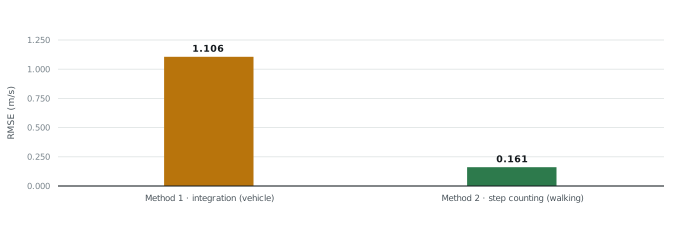
Why step counting beat integration by a factor of seven
A benchmark of two speed-estimation methods against 15 reference trials each, with a physical explanation of the error: integration drift grows with time, while event counting does not.
Read the projectNext
- A first paper, poster or conference report